
The Giving Tree
Overview
The Giving Tree is an American children’s picture book written and illustrated by Shel Silverstein. Harper & Row first published it on October 7, 1964. In spare prose and simple black-and-white drawings, Silverstein tells a story that can be read quickly but is difficult to settle into a single moral. Its brevity, memorable images, and open-ended emotional questions have helped make it one of his best-known works and a book shared by generations of children and adults.
Story and themes
A boy spends his childhood with an apple tree. He climbs its branches, swings from them, eats its apples, and rests in its shade. The tree loves him and is happy when he is near. As he grows older, however, the boy visits less often and returns mainly when he needs something. When he wants money, the tree offers its apples for him to sell. When he wants a house, it gives him its branches. Later, wishing to travel, he takes the trunk to make a boat. The tree is reduced to a stump. Years pass, and the now-old boy comes back saying that he needs only a quiet place to sit. Unable to offer fruit, branches, or a trunk, the tree gives him the stump, and the two are together once more.
The relationship at the center of the story is strikingly unequal: the tree gives repeatedly, while the boy’s requests change with his age and ambitions. Many readers interpret the tree’s generosity as unconditional love, parental care, or selfless devotion. Others see a troubling portrait of exploitation and one-sided dependence, and question whether the story presents self-erasure as a virtue. Because the tree is referred to as “she,” readers may also connect her with a mother or other caregiver, although Silverstein does not prescribe that interpretation. The book supplies no explicit verdict on the boy or the tree. Its final image can seem tender, poignant, troubling, or all three, depending on the reader. That ambiguity invites children to follow the events and gives adults substantial room to reconsider them.
Background and legacy
Silverstein later recalled that finding a publisher was difficult. People who encountered the manuscript could be moved by it, yet one objection was that it was too short; others thought it too sad or were unsure whether it belonged to children’s or adult literature. The search took about four years before editor Ursula Nordstrom helped bring it to publication. The very quality that made the book hard to classify became part of its reach: its plain language and uncluttered pictures make it accessible to young readers, while its questions about love, need, sacrifice, and responsibility remain open to argument.
The Giving Tree has been translated into numerous languages and has become a durable presence in children’s literature. It is often treated as a modern parable, but its reception has never been entirely settled. Admiration for the tree’s devotion exists alongside criticism of the boy’s demands and of the relationship’s imbalance. The book’s lasting influence rests not only on the instantly recognizable apple tree and boy, but also on its capacity to provoke conversation across generations. Readers may disagree about what the story teaches, yet the disagreement itself keeps the book alive: a short, spare picture book continues to prompt questions about how people give, what they owe one another, and whether love can remain generous without becoming self-consuming.
About the Author
Early life and education
Shel Silverstein, born Sheldon Allan Silverstein, was born in Chicago, Illinois, on September 25, 1930. He began drawing as a young child and later studied at the University of Illinois and the Chicago Academy of Fine Arts, though he did not follow a conventional academic path. His early interests in cartoons, drawing, and music helped shape an artistic career that crossed several fields. During his military service he also drew cartoons for the newspaper Stars and Stripes. Afterward, he became known for magazine cartooning, including work for Playboy. The concise images and irreverent humor he developed in that setting remained part of his style, even when he began writing for children.
Silverstein was not solely a children’s author. He was also a poet, cartoonist, songwriter, composer, and playwright. His work often joins comic surprise with loneliness, longing, or an unsettling edge. The apparently casual voice of his poems depends on careful rhythm, rhyme, and timing; his drawings are similarly economical, with a distinctive hand-drawn line. His experience in adult magazines and popular music helped him resist a strict division between writing for children and writing for adults. Rather than explaining every meaning, he often let an odd image or unresolved ending do the work.
Books and other work
Silverstein’s first children’s book, Lafcadio, the Lion Who Shot Back, appeared in 1963. The Giving Tree followed in 1964 and became one of his most widely recognized works. Among his other major books are Who Wants a Cheap Rhinoceros?; the poetry collection Where the Sidewalk Ends (1974); The Missing Piece (1976); A Light in the Attic (1981); and Falling Up (1996). The Missing Piece and its related work use spare, parable-like storytelling to explore absence, searching, and contentment. Falling Up continues his playful use of rhyme, strange situations, and sharp reversals. Runny Babbit was published posthumously in 2005, introducing more readers to his inventive wordplay.
He also wrote and performed songs and created work for the stage. Johnny Cash’s recording of Silverstein’s “A Boy Named Sue” became widely known in 1969. Silverstein’s song “I’m Checking Out,” written for the film Postcards from the Edge, received an Academy Award nomination for Best Original Song in 1991. His achievements in music, illustration, poetry, and drama reflect a career built across forms rather than within a single literary category.
Death and reputation
Silverstein died in Key West, Florida, on May 10, 1999, at the age of 68. He remains one of the most distinctive American writers and illustrators for young readers, admired for poems and stories that are funny without being merely comforting. His drawings and compact language are recognizable, but his lasting reputation also rests on his willingness to leave readers with questions. The Giving Tree exemplifies that quality: children may encounter a memorable story of a tree and a boy, while adults debate generosity, dependence, sacrifice, and responsibility. Across his books, songs, and cartoons, Silverstein made simplicity a source of complexity, creating work that continues to cross generations and invite sharply different readings.
StoryFlow

The Tree and the Boy’s Shared Childhood
This thread follows the closeness of The Tree and The Boy from playful childhood through the final, quieter form of their companionship.
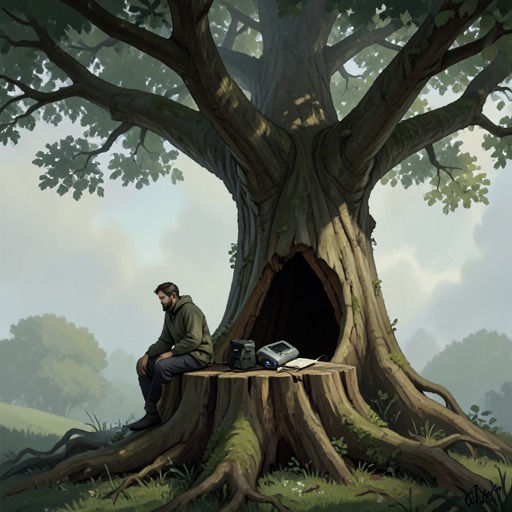
The Tree’s Giving Arc
This thread traces how The Tree’s offerings progress from shared playthings to the remaining stump, and how each gift changes what the tree can offer next.
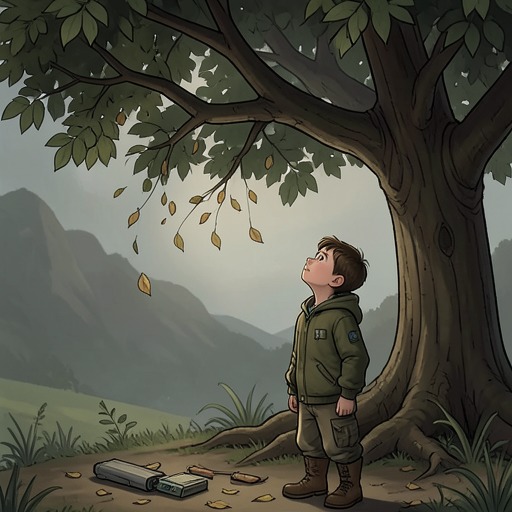
The Boy’s Changing Needs
This thread follows The Boy’s desires as they shift from play to money, a home, travel, and finally rest.
